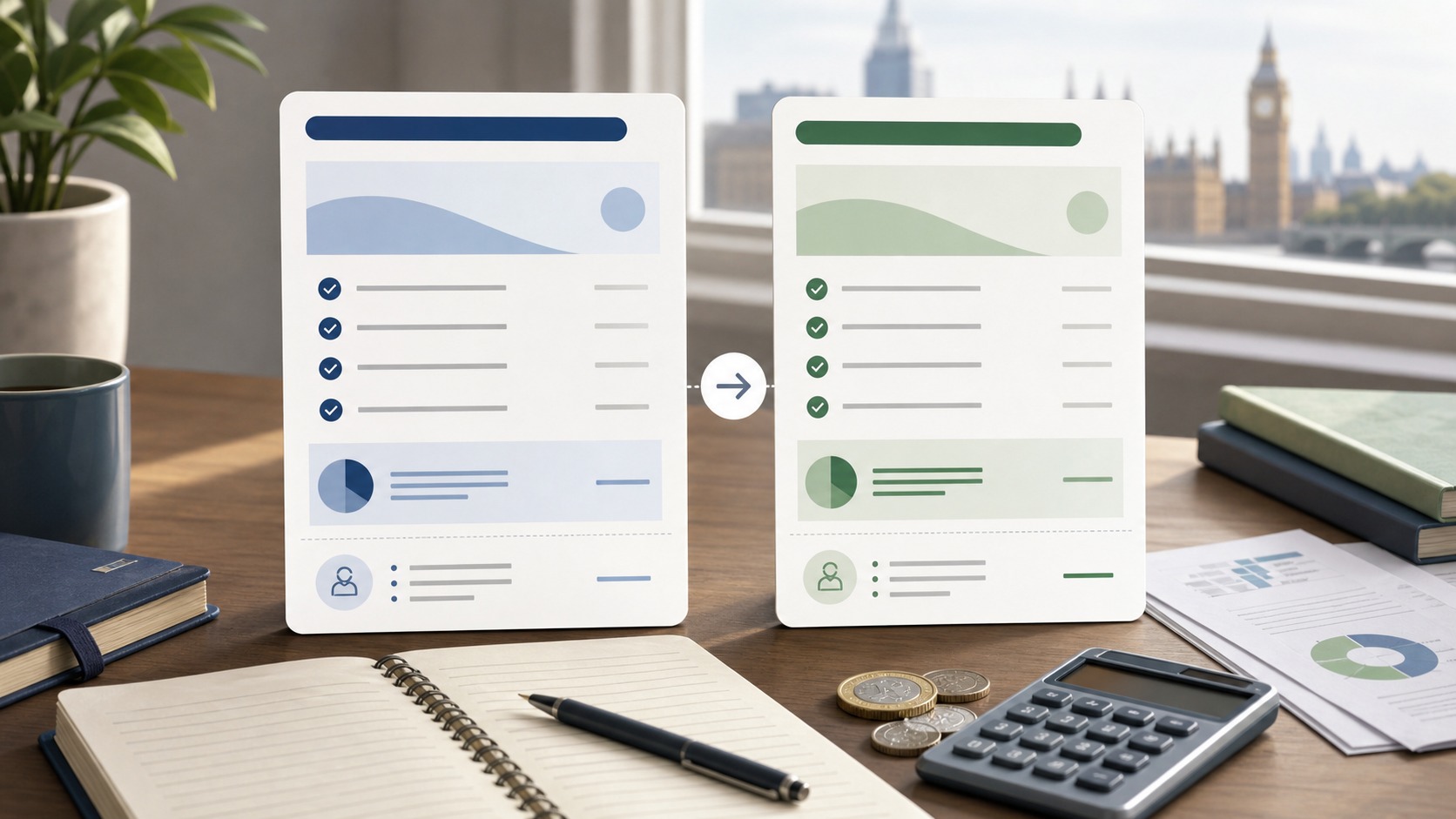
Choosing between Moneybox and Nutmeg is not just a question of which app looks easier. It is a question of how you want your investing habit to work: small automated contributions and a very simple portfolio menu, or a more structured managed investment service with risk-level choices and regular portfolio oversight.
This comparison is for UK readers looking at a Stocks and Shares ISA, not for anyone seeking personal financial advice. Investments can fall as well as rise, tax rules can change, and an ISA wrapper does not remove market risk. We may earn commission if you use certain provider links, but our editorial policy is to compare fees, risk, support and exit friction before conversion. Read more about our review standards on our editorial policy and about pages.
The short version: Moneybox is usually the more natural fit if you are trying to turn spare change, round-ups or small monthly deposits into an investing habit. Nutmeg is usually the more natural fit if you want the ISA to feel more like a managed portfolio service, with a clearer emphasis on risk levels, portfolio monitoring and guidance. Neither is automatically the right answer. The practical choice depends on fees at your balance size, how much control you want, and whether you may need to transfer later.
Moneybox vs Nutmeg ISA: quick comparison
| Check | Moneybox Stocks and Shares ISA | Nutmeg Stocks and Shares ISA | Why it matters |
|---|---|---|---|
| Main fit | Habit-led investing app with simple portfolio choices | Managed investing service with multiple risk levels | The user experience pushes different behaviour |
| Starting amount | Public editorial sources have reported that Moneybox can start from as little as £1 | Public editorial sources have reported higher minimums for ISAs than Moneybox | Minimums matter if you are trying investing with small amounts |
| Portfolio style | Simple options such as cautious, balanced and adventurous, with some ETF/stock choice for confident users | Fully managed and fixed allocation style choices, with more risk-level framing | This affects how much decision-making you outsource |
| Fee shape | Dated public sources reported a subscription fee, platform fee and fund costs; recheck the current Moneybox fees page | Dated public sources reported different total charges for fully managed and fixed allocation portfolios; recheck the current Nutmeg fees page | Small balances can be hit harder by fixed monthly fees |
| ISA allowance | Shares the same annual ISA allowance rules as other Stocks and Shares ISAs | Same ISA allowance framework | GOV.UK lists the 2026/27 annual ISA limit as £20,000 |
| Transfers | Check provider rules before moving an existing ISA | Check provider rules before moving an existing ISA | Transfer process, cash drag and market exposure can affect outcomes |
| Protection boundary | Investment FSCS protection may apply if conditions are met, but not for poor performance | Same regulatory boundary principle | FSCS protection is not a guarantee against market losses |
| Support style | App-led support and money-management features | Managed investing guidance and support pathways | Support matters when markets fall or a transfer stalls |
Fee note: provider pricing is refresh-sensitive. Before opening either account, check the current Moneybox pricing page and Nutmeg fees page. This article uses dated public editorial sources for comparison context and links to official pages for current checks.
1. Fee shape: small balance vs managed portfolio cost
The first practical question is not "which ISA is cheaper?" It is "which fee structure is cheaper for your balance and behaviour?"
A dated Guardian investing-app comparison reported Moneybox with a £1 monthly subscription, a 0.45% platform fee and fund costs for its core funds. The same comparison reported Nutmeg total charges that differed by portfolio style, with fully managed costing more than fixed allocation in the example used. Those figures are useful for understanding fee shape, but they should not be treated as permanent pricing.
For a small starter balance, a fixed monthly charge can matter more than it looks. Paying £1 a month on a very small pot can be proportionally heavier than a simple percentage fee. For a larger pot, the percentage platform and investment costs become more important. Nutmeg's managed model may cost more than a simple DIY ISA, but the tradeoff is that you are paying for a managed portfolio structure rather than building the portfolio yourself.
If you want to go deeper on the mechanics, start with our guide to comparing stocks and shares ISA platform fees. It explains why account fee, fund cost, dealing cost, FX fee and minimum monthly charges should be read together.
2. Portfolio choice: simple habit menu vs risk-level framework
Moneybox and Nutmeg both target people who do not want to build a full DIY portfolio from scratch, but they do it differently.
Moneybox is built around making saving and investing feel easy to start. Its public proposition has often been associated with round-ups, recurring deposits and simple portfolio labels such as cautious, balanced and adventurous. That can be useful if the hard part for you is getting started and investing consistently.

Nutmeg is more directly positioned as a managed investing service. Public comparisons describe fully managed and fixed allocation options, with risk levels that guide how the portfolio is built and monitored. That may suit readers who want a more explicit risk pathway rather than a very small set of simple portfolio labels.
The tradeoff is control. If you want to pick individual ETFs, shares or funds yourself, neither provider should be your only comparison. You should also read our Trading 212 vs Freetrade ISA comparison and AJ Bell vs Hargreaves Lansdown ISA comparison because those platforms sit closer to the DIY investing end of the spectrum.
3. Minimums and contribution habits
For first-time investors, minimum contribution rules can decide whether an ISA gets used at all.
Moneybox has a clear behavioural advantage if your goal is to start small and build the habit. Public editorial sources have reported a very low opening amount, and the round-up concept fits people who want investing to attach to daily spending behaviour. That is not a guarantee of better returns. It simply lowers the habit barrier.
Nutmeg may feel more serious from day one. If the minimum is higher at the time you check, that can be a useful filter. A higher minimum may stop you opening an account before you have an emergency cash buffer, a clear investing horizon and comfort with market volatility. For some readers, that friction is not a bad thing.
A sensible check is this: if you would panic after a 10% fall, do not use a tiny minimum as a reason to rush. Use the minimum only after you understand the portfolio risk level.
4. Transfer friction and exit planning
ISA transfers are one of the most overlooked parts of provider choice. A provider can look fine at account opening and still become frustrating when you want to consolidate accounts, change strategy or move to a lower-cost platform.
Before choosing Moneybox or Nutmeg, check three transfer details on the provider site:
- Can you transfer an existing Stocks and Shares ISA in?
- Will your existing investments be transferred as cash or in-specie?
- Are there exit fees, closure rules, market-out-of-time issues or minimum balance limits?
Cash transfers can leave you out of the market for a period. In-specie transfers can preserve holdings but may only work when both platforms support the same assets. Managed portfolio services often hold investments in a structure that may not map cleanly to another platform. That does not make them wrong, but it means exit friction should be part of the decision.
The 2026/27 ISA allowance listed by GOV.UK is £20,000, but allowance rules do not remove the need to follow official ISA transfer procedures. Do not withdraw money manually if your goal is to preserve ISA status. Use the receiving provider's ISA transfer process.
5. Risk, FSCS and FCA checks
A Stocks and Shares ISA is a tax wrapper. It is not a safety wrapper.
The Financial Services Compensation Scheme says investment claims can be covered up to £85,000 per eligible person, per firm when conditions are met, but it also states that poor investment performance is not covered. In plain English: if a regulated investment provider fails and there is a shortfall in client assets, FSCS protection may matter. If your portfolio falls because markets fall, FSCS does not reimburse that loss.

Before opening either provider, use the FCA Firm Checker or Financial Services Register to confirm the firm and the regulated activity. The detail matters because FSCS protection depends not only on the firm being authorised, but also on the service and product being regulated.
This is especially important with app-based finance products because users often mix up three different protections: bank deposit protection, investment compensation and e-money safeguarding. Moneybox and Nutmeg ISA decisions sit in the investment-risk category, not the cash savings category.
6. Support and guidance
Support matters most when something goes wrong: a transfer is delayed, markets fall, a fee is unclear, or you need to understand why your portfolio changed.
Moneybox may appeal if you want a broader app-led money-management experience. Its savings and investing ecosystem can feel familiar if you are already using finance apps for automatic saving. The question is whether the support experience is enough when your question is not simply "how do I deposit?" but "why is my cautious portfolio exposed to these assets?"
Nutmeg may appeal if you want the ISA to feel closer to a managed investment account. Public sources describe guidance and advice options, with paid advice available for readers who need a fuller recommendation. That can be helpful, but guidance and regulated financial advice are not the same thing. If you need personal advice, check the scope and cost before relying on it.
A useful rule: if you cannot explain your portfolio risk level back to yourself in one sentence, pause before funding the ISA.
7. When Moneybox may fit better
Moneybox may be the better starting point if your main problem is consistency. If you have delayed investing because every platform feels too complex, an app that turns deposits and round-ups into a repeatable habit can be useful.
It may also fit if you want your money tools in one place. Readers comparing Moneybox to savings apps may also find our Chip vs Plum savings app comparison useful because it covers a similar behavioural question: are you choosing the product because it has the strongest headline feature, or because it helps you act consistently?
Moneybox is less compelling if you already know which ETFs, funds or shares you want. In that case, compare DIY ISA platforms and check dealing costs, FX fees and fund range.
8. When Nutmeg may fit better
Nutmeg may fit better if you want a managed portfolio service and are comfortable choosing a risk level rather than building a portfolio manually. It may also suit readers who want a clearer separation between saving habits and investment management.
The tradeoff is that you need to understand the service tier. Fully managed and fixed allocation approaches can have different costs and review patterns. Do not compare Nutmeg to Moneybox only on headline percentage cost. Compare what is being managed, how often it is reviewed, and whether you would still be comfortable if the portfolio underperforms cash or a DIY tracker for a period.
Nutmeg is less compelling if you mainly want to start with a very small balance, experiment with round-ups or keep all money-management behaviour inside one app.
Internal links for related ISA decisions
If you are still choosing the broad category, read our ISA platform fee guide first. If you want a DIY app comparison, read Trading 212 vs Freetrade ISA. If you are comparing established investment supermarkets, read AJ Bell vs Hargreaves Lansdown ISA. If your main interest is automated savings behaviour rather than investment portfolios, read Chip vs Plum savings app.
Quick verdict
Choose Moneybox when you want to start small, build a contribution habit and keep the portfolio choice simple. Choose Nutmeg when you want a more managed ISA experience with risk-level framing and are comfortable checking the current minimum and fee schedule before opening.
Do not choose either purely because an app makes investing feel easy. The real decision is whether the portfolio, fee structure, transfer process and support model still make sense after the novelty of opening the account has passed.
FAQ
Is Moneybox or Nutmeg cheaper for a Stocks and Shares ISA?
It depends on your balance, portfolio type and current fee schedule. Dated public comparisons have shown Moneybox with a subscription-plus-platform-fee structure and Nutmeg with different total costs for fully managed and fixed allocation portfolios. Check the current provider fee pages before opening because small changes can materially affect small balances.
Is Moneybox or Nutmeg better for beginners?
Moneybox may feel easier if you want small deposits, round-ups and a simple investing habit. Nutmeg may feel clearer if you want a managed portfolio with risk levels and portfolio oversight. Beginner-friendly does not mean risk-free. You still need to understand market falls, fees and transfer rules.
Can I transfer an ISA from Moneybox to Nutmeg or from Nutmeg to Moneybox?
Usually you should use the receiving provider's ISA transfer process rather than withdrawing manually. The exact process can depend on whether assets move as cash or in-specie, whether the receiving provider supports the same investments, and whether either side has transfer restrictions. Check both providers before starting.
Does FSCS protect my Moneybox or Nutmeg ISA?
FSCS investment protection may apply if the relevant conditions are met, up to £85,000 per eligible person, per firm for firms failing after 1 April 2019. It does not cover normal poor investment performance. Always check the firm, regulated activity and product scope before relying on protection.
Should I use a managed ISA or a DIY ISA platform?
Use a managed ISA if you want the provider to build and maintain the portfolio around a risk profile. Use a DIY ISA if you want to choose funds, ETFs or shares yourself and are comfortable managing allocation and rebalancing. Compare fees carefully because the cheaper option is not always the better fit for behaviour and confidence.
Sources and freshness notes
- Moneybox Stocks and Shares ISA
- Moneybox pricing
- Nutmeg Stocks and Shares ISA
- Nutmeg fees
- GOV.UK Individual Savings Accounts
- FSCS investment compensation
- FCA Firm Checker
- The Guardian investing apps comparison, 21 June 2025
- MoneyWeek stocks and shares ISA guide
Last reviewed: 3 July 2026. Provider fees, minimums, portfolio labels and transfer rules can change, so treat fee figures as refresh-sensitive and recheck official provider pages before acting.